
the Creative Commons Attribution 4.0 License.
the Creative Commons Attribution 4.0 License.
 | 06 Oct 2026
Unveiling potential genetic markers: associations of IGF1R eon 13 and Intronic polymorphisms with growth traits in yak
Xinyue Liu
Yincang Han

Yonggang Sun
Fajie Gou
Jianyu Chen
Weiqiang Jiang
Qingye Zhao
This study aimed to investigate the associations between single-nucleotide polymorphisms (SNPs) and haplotypes in the exon 13 and the intronic regions of the yak IGF1R gene and growth traits, with the goal of identifying molecular markers related to growth performance. A total of 400 3-year-old female yaks from the Qinghai Plateau were used as the experimental population. DNA sequencing was employed to detect and genotype SNPs in the IGF1R gene. Haploview 3.32 software was used for linkage disequilibrium and haplotype analysis, and the associations between different genotypes and haplotype combinations with growth traits, including body weight, body height, body length, chest circumference, and cannon bone circumference, were evaluated. One SNP (g.7383084C>T) was identified in exon 13, and three SNPs (g.7383136G>A, g.7383137C>T and g.7383177G>A) were identified in intron 13. Haplotype and linkage disequilibrium analyses revealed weak linkage among the four loci, and six haplotypes were identified, among which Hap2 was the dominant one. Association analysis of growth traits indicated that g.7383084C>T, g.7383136G>A, g.7383137C>T, and g.7383177G>A loci were significantly or highly significantly associated with body height and body length in plateau yaks. The advantageous genotypes were CC and CT for g.7383084C>T, GA for g.7383136G>A, CT for g.7383137C>T, and GG for g.7383177G>A. Genotype combination analysis showed that all five common diplotypes were significantly associated with some growth traits, with H2H6 being the optimal haplotype combination. These results suggest that polymorphisms in the exon 13 and intronic regions of the IGF1R gene in Qinghai Plateau yaks can serve as molecular markers. The significant associations with growth traits provide data-based support for their direct application in the genetic improvement and efficient breeding of yaks.
- Article
(1313 KB) - Full-text XML
- BibTeX
- EndNote


The yak (Bos grunniens) is native to the Qinghai–Tibet Plateau and adjacent alpine regions. As the only large domestic animal adapted to extremely high-altitude environments, it is often referred to as the “ship of the plateau” and “all-purpose livestock” (Wang et al., 2024). It can efficiently utilize alpine meadow forage resources, providing local communities with meat, milk, draft power, hides, fuel, and other livelihood products (Joshi et al., 2020). China's yak population exceeds 15 million heads, accounting for over 95 % of the global total (Han and Liang, 2024). In yak production practices, nutritional regulation measures such as supplementary feeding during the cold season can improve production performance to a certain extent. However, the ultimate level of production performance achievable is fundamentally determined by the yak's genetic potential. With the rapid development of molecular genetics and sequencing technologies, molecular markers have been widely adopted. In livestock, genetic variants, including single-nucleotide polymorphisms (SNPs), small insertions and/or deletions (InDel, < 50 bp), and copy number variations (CNVs), are widespread across the genome and may contribute to phenotypic diversity and economically important traits (Zhang et al., 2024). As the most commonly used method for assessing genetic diversity in animal populations, SNP molecular markers are characterized by a wide distribution, high density, abundant loci, and high genetic stability within the genome (Guo et al., 2024).
The insulin-like growth factor (IGF) family consists of two ligands (IGF-1 and IGF-2), corresponding receptors (IGF1R and IGF2R), and six binding proteins (IGFBP-1-IGFBP-6) (Annunziata et al., 2011). As multifunctional bioactive peptides, IGFs directly participate in the regulation of animal growth and development; reproductive, nutrition, and metabolic processes; and fundamental cellular activities, including cell proliferation, differentiation, and apoptosis. They also mediate the growth-promoting effects of the growth hormone (GH). As a key receptor in the IGF system, IGF1R mediates its core biological functions and is widely expressed across many tissues and cell types. Therefore, genetic variations in this gene may perturb hormone-signaling pathways and thereby influence growth and reproductive traits. The IGF1R is expressed in B and T lymphocytes; in thyroid cells and osteoblasts; and in tissues including the liver, brain, stomach, kidney, heart, lung, muscle, and bone (Denley et al., 2005). During embryonic and postnatal development, IGF1R participates in immune regulation, lymphocyte production, and muscle and bone development (DeChiara et al., 1990). IGF1R is a core component of the neuroendocrine growth axis, and its function depends on the synergistic effect of GH and IGF. In addition to altering the encoded amino-acid sequence, variants in IGF1R may influence gene function by affecting pre-mRNA processing, transcript abundance, or receptor expression. Variants within exon 13 or its flanking intronic sequences may disrupt exonic or intronic splicing regulatory elements and, when located near exon–intron boundaries, canonical splice-site signals. Such alterations can affect exon recognition or splice-site selection and may consequently lead to aberrant transcripts, including exon skipping, intron retention, or cryptic splice-site activation (Cartegni et al., 2002; Scotti and Swanson, 2016; Abramowicz and Gos, 2018). Although direct functional evidence for variants in this specific IGF1R region remain limited, these potential molecular consequences provide a rationale for investigating IGF1R polymorphisms in relation to growth-related traits in yak.
Numerous studies report associations between IGF1R polymorphisms and economically important traits in livestock. In cattle, copy number variation (CNV) and insertion/deletion (InDel) polymorphism of IGF1R are significantly associated with body weight, withers height, chest girth, and body length (Ma et al., 2019; Tang et al., 2021). Another study reported that SNPs in specific IGF1R exons are associated with the weaning weight of Angus cattle (Szewczuk et al., 2013). In addition, IGF1R CNV is associated with body weight and withers height in Jinnan cattle and with withers height and hip width in Qinchuan cattle; however, no such associations were detected in Nanyang or Xianan cattle, indicating that its genetic effect may vary by breed (Ma et al., 2019). Beyond growth traits, meta-analyses and transcriptomic data indicate that IGF1R participates in the regulation of feed efficiency, AMP-activated protein kinase (AMPK)-related pathways, intramuscular fat (IMF) deposition, and fatty-acid metabolism in beef cattle and promotes muscle cell proliferation and differentiation (Liu et al., 2024; Mota et al., 2022). In sheep, IGF1R polymorphisms are also associated with growth performance; one study reported significant associations between several SNPs and five growth traits (Ding et al., 2022). In Polish Merino sheep, the IGF1R variant c.654G>A has been associated with average daily gain and foreleg weight, as well as meat quality traits including loin eye depth, intramuscular fat content, and water-holding capacity (Grochowska et al., 2021). In pigs, IGF1R expression is associated with fecundity. It shows a distinct pattern in high-fecundity sows, with the highest hepatic expression in replacement gilts at 60 and 90 d of age, suggesting that it may be involved in the developmental regulation of reproductive traits (Pierzchała et al., 2012; Zhao et al., 2018). Therefore, this study aimed to screen IGF1R SNPs in Qinghai Plateau yaks, identify loci associated with growth traits, and evaluate their effects through association analyses in order to provide a theoretical basis for molecular-marker-assisted breeding of yaks.
2.1 Experiment material
In Bianma Meilongzhang Cooperative, Yeniugou Township, Qilian County, Haibei Tibetan Autonomous Prefecture, Qinghai Province, 400 healthy adult 3-year-old Qinghai Plateau female yaks were randomly selected as the research objects. First, their growth indicators, including body weight, body length (oblique), body height, chest circumference, and cannon bone circumference, were measured; then 10 mL of whole blood was collected from the jugular vein, anticoagulated with ACD solution at a volume ratio of (VACD:Vblood = 1:6), and gently oscillated to mix thoroughly; finally, the treated blood samples were stored at −80 °C for subsequent genomic DNA extraction and analysis.
2.2 Genomic DNA extraction and detection
The genomic DNA of yaks was extracted using a blood genomic DNA extraction kit (Sikejie, Shandong). Subsequently, a NanoDrop 2000 spectrophotometer (Thermo Fisher Scientific, USA) was used to determine the concentration and purity of the extracted DNA, and qualified samples were stored at −20 °C for later use. The concentration of all DNA samples used in this experiment was higher than 50 ng µL−1, and the ratio was above 1.8.

2.3 Primer design and PCR amplification
Based on the gene sequence of yak IGF1R (NC_091637.1) in GenBank, PCR primers were designed using Primer 5.0 software (Table 1) and synthesized by Sangon Biotech (Shanghai) Co., Ltd.
The 25.0 µL PCR reaction system contained the following components: 12.5 µL mix solution (Sikejie, Shandong, containing deoxynucleoside triphosphates (dNTPs) with nucleic acid dye, Taq DNA polymerase, and 10× Buffer), 9.5 µL ddH2O, 1.0 µL each of forward and reverse primers (20 µmol L−1), and 1.0 µL DNA. The amplification reaction was carried out according to the following program: pre-denaturation at 95 °C for 3 min; 35 cycles of pre-denaturation at 95 °C for 30 s, annealing at 59 °C for 30 s, and extension at 72 °C for 30 s; and final extension at 72 °C for 5 min, followed by storage at 4 °C. Finally, 0.8 % agarose gel electrophoresis was used to detect the amplification results.
2.4 SNP detection
PCR products with good amplification quality were entrusted to Sangon Biotech (Shanghai) Co., Ltd. for purification and sequencing. The obtained sequences were aligned using Seqman software to identify the SNP sites therein.
2.5 Data statistical analysis
Based on the genotyping data, the genotype and allele frequencies, genetic heterozygosity (He), effective number of alleles (Ne), and polymorphism information content (PIC) of each polymorphic locus were calculated. SPSS 25.0 software was used to perform a chi-square test on the genotype distribution of the IGF1R gene locus in the population, and the Hardy–Weinberg equilibrium (HWE) status was determined according to the following criteria: if , the locus was considered to be in equilibrium; if , it was in disequilibrium; if , it was in significant disequilibrium. Furthermore, Haploview 3.32 software was used to conduct linkage disequilibrium and haplotype analysis on the four SNP loci of the IGF1R gene. To evaluate the effect of different genotypes on growth traits, age and environment were included as covariates in the fixed model to analyze its genetic effect.
In the above, Yij denotes individual record phenotypic, μ denotes population mean, Gi denotes marker genotype effect, Aj denotes age effect, and Eij denotes random error.
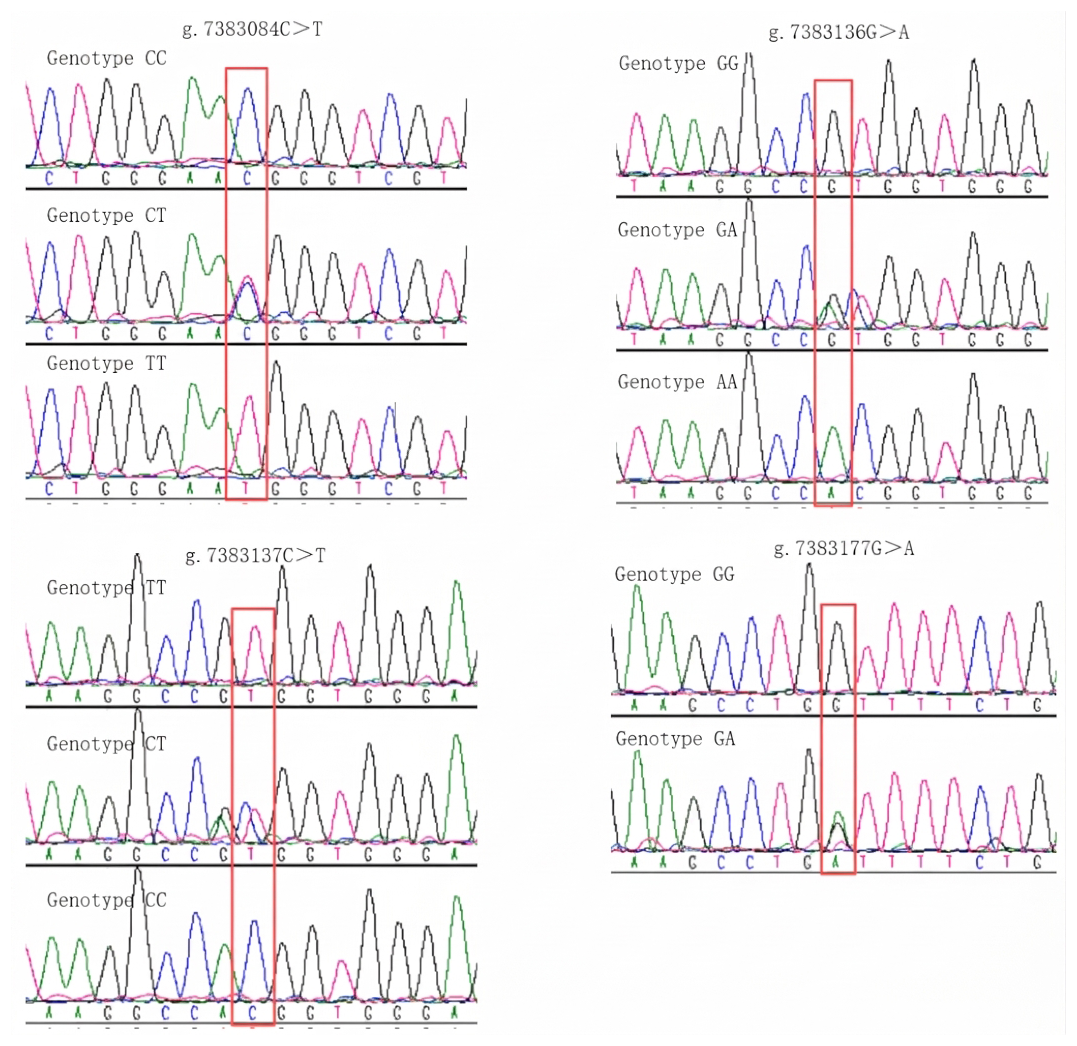
Figure 1Sequencing of four loci of the IGF1R gene. Sanger sequencing chromatograms of different genotypes at four single-nucleotide polymorphism loci. Red boxes indicate the variant sites. The genotypes identified were CC, CT, and TT at g.7383084C>T; GG, GA, and AA at g.7383136G>A; TT, CT, and CC at g.7383137C>T; and GG and GA at g.7383177G>A. Heterozygous genotypes show overlapping peaks corresponding to the two nucleotides, whereas homozygous genotypes show a single peak. Peak colors represent A (green), T (red), C (blue), and G (black).
3.1 Analysis of genetic characteristics of IGF1R gene SNPs
The full length of the IGF1R gene in yaks is 305 476 bp, which consists of 21 exons and 20 introns. Sequencing of the amplified IGF1R gene fragments in the study population identified four SNPs (Fig. 1). One SNP, g.7383084C>T, was located in exon 13, whereas three SNPs – g.7383136G>A, g.7383137C>T, and g.7383177G>A – were located in intron 13. Both g.7383084C>T and g.7383137C>T have three genotypes, namely CC, CT, and TT; g.7383136G>A has three genotypes, namely GG, GA, and AA; and g.7383177G>A has two genotypes, namely GG and GA.
Table 2Genetic polymorphism analysis of IGF1R gene in yak.
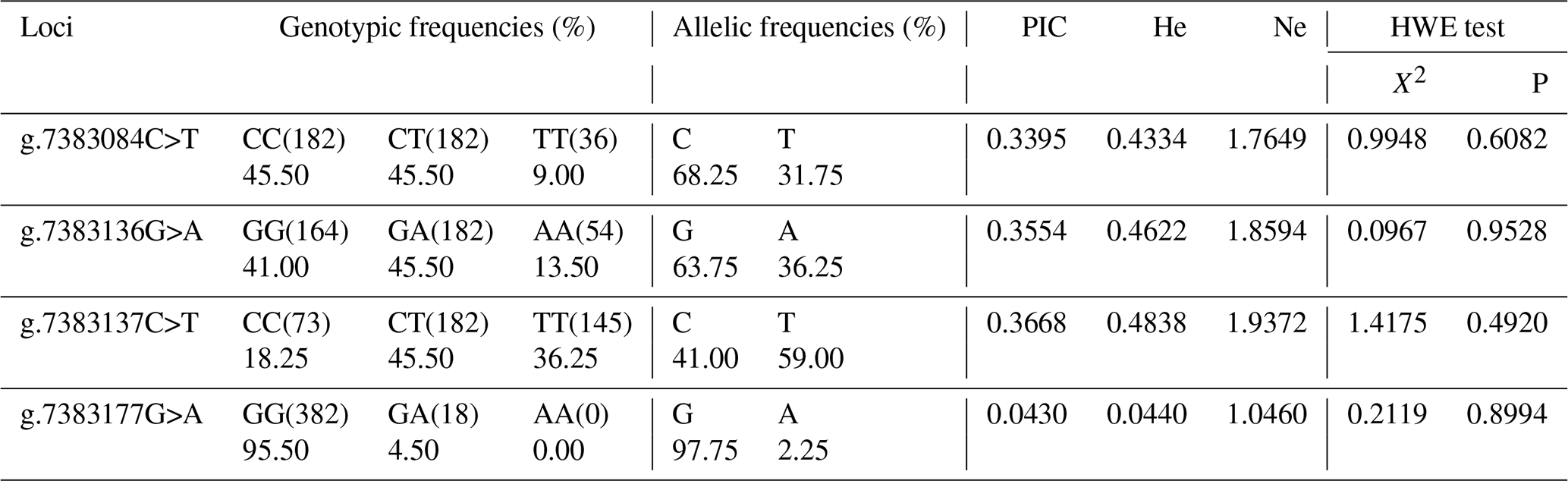
Note: PIC > 0.5 means high diversity, 0.25 < PIC < 0.5 means moderate diversity, and PIC < 0.25 means low diversity; df = 2, = 5.991, and = 9.21; P>0.05: consistent with HWE.
The results of genetic polymorphism analysis of the yak IGF1R gene are shown in Table 2. For the g.7383084C>T site on IGF1R, the dominant genotypes are CC and CT, with no single dominant genotype, and the dominant allele is C. The dominant genotype of g.7383136G>A is GA, the dominant genotype of g.7383177G>A is GG, and their dominant alleles are both G. The dominant genotype of the g.7383137C>T mutation site is CT, and the dominant allele is T. The chi-square test showed that all four mutation sites (g.7383084C>T, g.7383136G>A, g.7383137C>T, and g.7383177G>A) are in complete Hardy–Weinberg equilibrium (P>0.05). The g.7383177G>A site is at a low polymorphism level (PIC < 0.25), while g.7383084C>T, g.7383136G>A, and g.7383137C>T are at a moderate polymorphism level (0.25 < PIC < 0.5).
Table 3Effect of different genotypes of IGF1R on growth traits in yak.
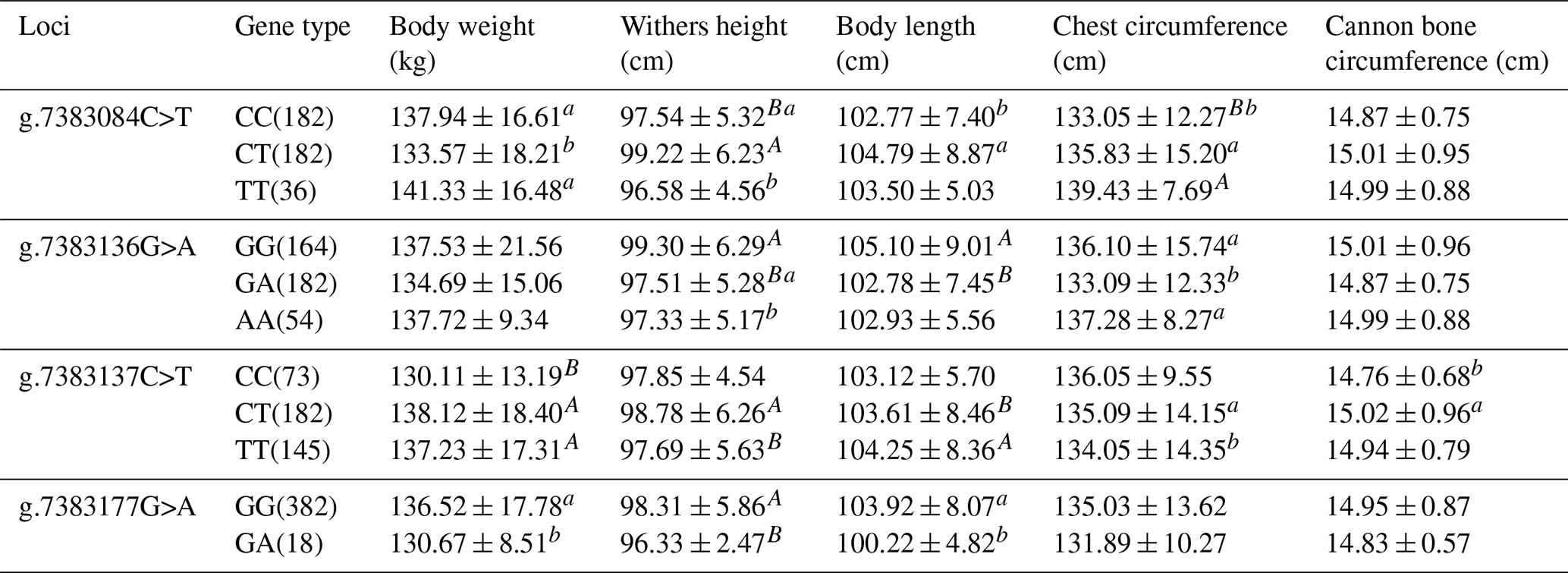
Note: data in the table are “mean ± SD”. The difference in terms of lowercase letters in the upper-right corner of the same column indicated significant difference (P<0.05), while the difference in terms of capital letters indicated extremely significant difference (P<0.01); values without superscript letters do not differ significantly from the other genotype groups for the corresponding trait (P>0.05). The same is applied below.
3.2 Effects of IGF1R gene mutation locus genotype on growth traits in yak
As shown in Table 3, the IGF1R g.7383084C>T locus was significantly associated with body weight, withers height, body length, and chest circumference. Carriers of the CC and TT genotypes had significantly higher body weight than carriers of the CT genotype (P<0.05). Withers height was significantly higher in carriers of the CT genotype than in carriers of the CC genotype (P<0.01), whereas carriers of the CC genotype had significantly higher values than carriers of the TT genotype (P<0.05). Carriers of the CT genotype had significantly greater body length than carriers of the CC genotype (P<0.05). For chest circumference, carriers of the TT genotype had significantly higher values than carriers of the CC genotype (P<0.01), whereas carriers of the CT genotype had significantly higher values than carriers of the CC genotype (P<0.05). No significant differences in cannon bone circumference were observed among the genotypes (P>0.05). At the g.7383136G>A locus, the GG genotype had significantly higher withers height and body length than the GA genotype (P<0.01), and the GA genotype had significantly higher withers height than the AA genotype (P<0.05). Chest circumference was significantly higher in carriers of the GG and AA genotypes than in carriers of the GA genotype (P<0.05). No significant differences in body weight or cannon bone circumference were observed among the genotypes (P>0.05). The g.7383137C>T locus was significantly associated with body weight, withers height, body length, chest circumference, and cannon bone circumference. Carriers of the CT and TT genotypes had significantly higher body weight than carriers of the CC genotype (P<0.01). For withers height, carriers of the CT genotype had significantly higher values than carriers of the TT genotype (P<0.01). For body length, carriers of the TT genotype had significantly higher values than carriers of the CT genotype (P<0.01). Chest circumference was significantly higher in carriers of the CT genotype than in those with the TT genotype (P<0.05). Cannon bone circumference was significantly higher in carriers of the CT genotype than in those with the CC genotype (P<0.05). The IGF1R g.7383177G>A locus was significantly associated with body weight, body length, and withers height. Carriers of the GG genotype had significantly higher body weight and body length than carriers of the GA genotype (P<0.05). Withers height was also significantly higher in carriers of the GG genotype than in carriers of the GA genotype (P<0.01). No significant differences in chest circumference or cannon bone circumference were observed between the two genotypes (P>0.05).
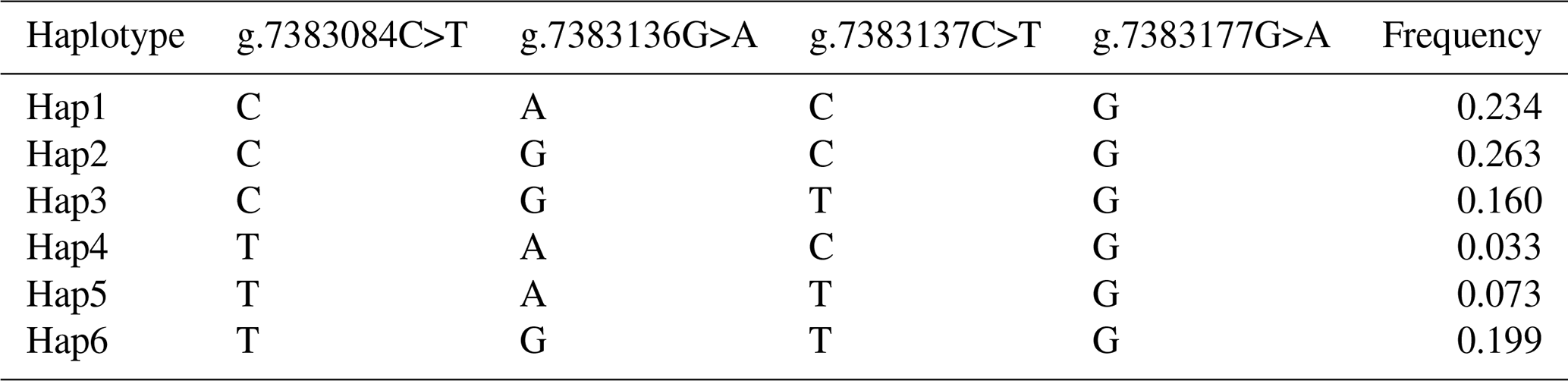
3.3 Haplotype and linkage disequilibrium analysis of IGF1R gene SNPs
Haplotype analysis of the four SNPs on the IGF1R gene, after excluding haplotypes with a frequency below 3.00 %, detected six haplotypes designated Hap1–Hap6 (Table 4). Haplotype Hap2 had the highest frequency (0.263) and was the major haplotype, while haplotype Hap4 had the lowest frequency (0.033).
Table 5Analysis of IGF1R mutation site linkage disequilibrium in yak.
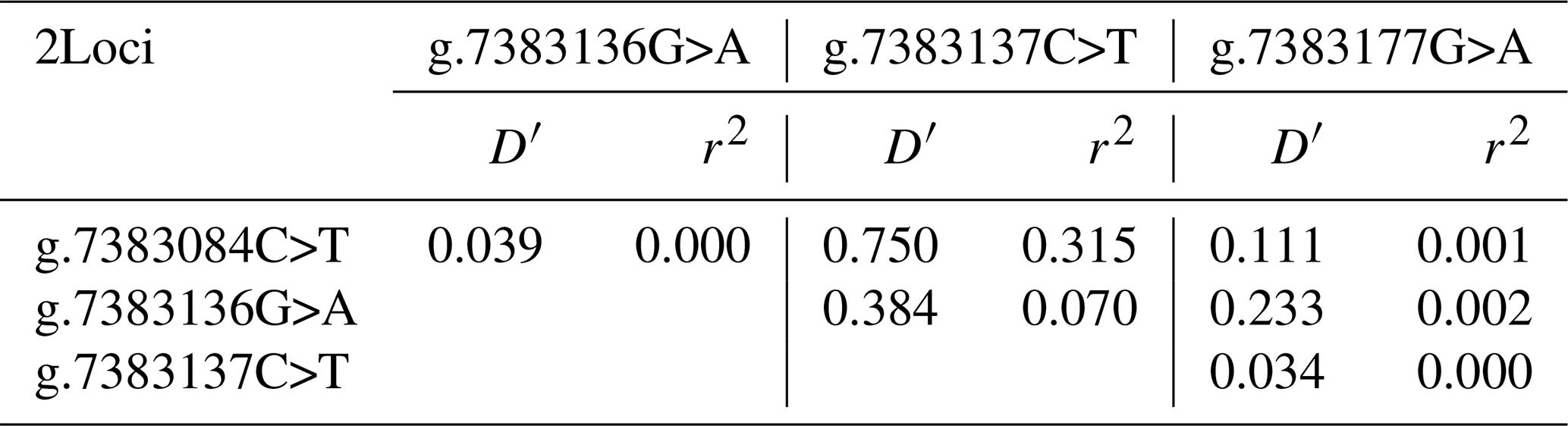
Linkage disequilibrium analysis revealed (Table 5) no strong linkage among the four SNP loci. The D′ values between each pair of the four SNPs were all < 0.8, and the r2 values were all < 0.33 (in this study, strong linkage disequilibrium was operationally defined as D′ > 0.8 together with r2 > 0.33) (Slatkin, 2008).
Table 6Correlation analysis of IGF1R mutation site diplotypes and growth traits in yak.

3.4 Effects of combined haplotypes of IGF1R gene SNPs on growth traits in yak
As shown in Table 6, combined-haplotype H2H6 had significantly higher body weight than H3H1 (P<0.05) and significantly higher withers height and body length than H3H1 (P<0.01). For withers height, H2H6 was significantly higher than H3H1 and H4H5 (P<0.01) and significantly higher than H2H1 (P<0.05). For body length, H3H6 and H2H1 were also significantly higher than H3H1 (P<0.05). Regarding chest circumference, H2H1, H2H6, and H4H5 were significantly higher than H3H1 (P<0.01), and H3H6 was significantly higher than H3H1 (P<0.05). Therefore, in this experimental population, the combined haplotype H2H6 may be the optimal combined haplotype influencing growth traits in yaks.
Growth traits are key indicators of livestock growth, development, and economic value, playing a significant role in breeding. Animal growth and development are precisely regulated by the growth hormone GH–IGF1 axis, which plays a crucial role in body growth, development, and anabolic processes. As the core regulator of this pathway, GH biological functions are primarily mediated through the binding of IGF1 to its receptor, IGF1R (Renaville et al., 2002). IGF1R has a high affinity for IGF1 and is considered to be a potential quantitative trait locus (QTL) that influences traits like growth, carcass traits, and reproductive performance (Kawashima et al., 2005). In the present study, several favorable genotypes of IGF1R were associated with yak body measurement traits. Specifically, the favorable genotypes were CC and CT at g.7383084C>T, GA at g.7383136G>A, CT at g.7383137C>T, and GG at g.7383177G>A. Individuals carrying these genotypes showed significant differences in withers height, body length, and related body measurement traits compared with individuals carrying other genotypes. This observation is consistent with previous reports in multiple Chinese yak populations, including Datong yak, Qinghai Plateau yak, Tianzhu White yak, Gannan yak, and Xinjiang yak, in which polymorphism variants located in exon 1 of the IGF1R gene were shown to exert significant effects on early postnatal growth and development (Liang et al., 2010). Combined with these earlier findings, our results further support the hypothesis that sequence polymorphisms in different regions of the yak IGF1R gene, both in exons and in flanking introns, can contribute to phenotypic variation in growth traits across different developmental stages and genetic backgrounds. These marker trait associations are biologically plausible because IGF1R is a key upstream mediator of IGF1-dependent signaling that directly regulates chondrocyte proliferation, longitudinal bone growth, and systemic skeletal development, all of which are fundamental processes underlying body size and body conformation formation in yaks (Kawashima et al., 2005). Therefore, the variants identified in the exon 13–intron 13 region of the yak IGF1R gene may be considered to be promising candidates for marker-assisted selection aiming at improving growth performance in local yak-breeding programs.
The effective allele number, heterozygosity, and polymorphic information content are key indicators of a gene fragment’s polymorphism and the population’s genetic variation. These indicators reflect genetic similarity among individuals within a population; higher values generally indicate greater genetic variation. In family-based breeding systems, genetic loci with a large effective number of alleles, high polymorphism information content, and high heterozygosity can be used for marker-assisted selection in conjunction with association analyses of important production traits, thereby providing a genetic basis for improving livestock and poultry production performance. In the present study, four SNPs were detected in the exon 13–intron 13 region of the yak IGF1R gene, including g.7383084C>T, g.7383136G>A, g.7383137C>T, and g.7383177G>A. At the g.7383084C>T locus, 182 individuals had the CC genotype, 182 had the CT genotype, and 36 had the TT genotype. At the g.7383136G>A locus, 164, 182, and 54 individuals carried the GG, GA, and AA genotypes, respectively. At the g.7383137C>T locus, the numbers of individuals with the CC, CT, and TT genotypes were 73, 182, and 145, respectively. At the g.7383177G>A locus, 382 individuals carried the GG genotype, whereas 18 carried the GA genotype. The exonic variant g.7383084C>T was a synonymous substitution that did not alter the encoded amino acid as both alleles encoded aspartic acid. However, synonymous variants should not be regarded as functionally neutral a priori because they may influence codon usage bias, mRNA secondary structure, mRNA stability, translation efficiency, co-translational protein folding, or exonic-splicing regulatory elements (Sauna and Kimchi-Sarfaty, 2011; Hunt et al., 2014; Wang et al., 2020). Therefore, g.7383084C>T may affect yak growth traits by modulating IGF1R transcript processing or expression efficiency, or it may be in linkage disequilibrium with another functional variant in the IGF1R gene. The variants g.7383136G>A and g.7383137C>T were located 9 and 10 bp downstream of exon 13, respectively, suggesting that they are near-exon intronic variants positioned close to the exon–intron boundary, whereas g.7383177G>A was located within intron 13. Although intronic variants do not alter the amino acid sequence directly, variants close to exon–intron boundaries may affect pre-mRNA splicing by altering splice donor recognition, exon definition, intronic splicing enhancers, intronic splicing silencers, or other cis-regulatory elements (Chiang et al., 2022). In particular, intronic positions near +9 and +10 downstream of an exon may lie within regions relevant to splice-site recognition and early spliceosomal assembly, suggesting that g.7383136G>A and g.7383137C>T could potentially influence IGF1R transcript structure, transcript abundance, or isoform composition (Pagani and Baralle, 2004; Chiang et al., 2022). The intronic variant g.7383177G>A is farther from the exon–intron boundary and exhibited low polymorphism (PIC < 0.25), indicating limited genetic variability and relatively weak potential for single-locus selection; nevertheless, it may still contribute to phenotypic variation as part of a haplotype background. All four loci conformed to Hardy–Weinberg equilibrium (P>0.05), suggesting that they were in a relatively stable genetic state in the sampled yak population. By contrast, g.7383084C>T, g.7383136G>A, and g.7383137C>T showed moderate polymorphism (0.25 < PIC < 0.5), indicating that these loci retain sufficient allelic diversity for evaluating genotype–phenotype associations and may serve as useful candidate markers for marker-assisted selection of yak growth traits. Taken together, the synonymous exonic variant and near-exon intronic variants identified in this study may influence yak growth traits through regulatory mechanisms affecting IGF1R mRNA processing, expression, or linkage with causal variants.
From a quantitative genetic perspective, additive genetic effects represent an important component of heritable variation in complex traits and provide the basis for allele substitution effects and breeding-value prediction (Falconer and Mackay, 1996; Lynch and Walsh, 1998; Mrode, 2014). For a biallelic locus, a potential additive pattern is suggested when phenotypic values change progressively with the number of alternative alleles and the heterozygous genotype is approximately intermediate between the two homozygous genotypes. In the present study, formal additive–dominance models were not fitted; therefore, the observed genotype differences cannot be regarded as direct evidence of additive genetic effects. Nevertheless, some genotype means showed potential allele dose tendencies for individual traits. For example, chest circumference at g.7383084C>T increased from CC to CT and TT, suggesting a possible positive dose-related association of the T allele with chest circumference. At g.7383137C>T, body length showed an increasing tendency from CC to CT and TT, whereas chest circumference showed a decreasing tendency with increasing T-allele dosage. These trait-specific patterns suggest that some IGF1R variants may contribute to phenotypic variation through potentially additive or partially additive mechanisms. However, several traits did not follow a strictly linear genotype–phenotype pattern, and heterozygote superiority or genotype-specific effects were observed at some loci. Such patterns may reflect dominance, overdominance, linkage disequilibrium with functional variants, or differences in local haplotype background. Therefore, the present findings should be interpreted as preliminary evidence of potential allele dose tendencies (Falconer and Mackay, 1996; Lynch and Walsh, 1998; Mackay et al., 2009). In addition to single-locus effects, the joint inheritance of linked variants, as captured by haplotypes and diplotypes, may also contribute to phenotypic variation in animal growth traits. Previous studies have reported associations between ADIPOQ haplotype combinations and body measurements in Qinchuan cattle (Zhang et al., 2013), as well as associations between Dapper1 haplotypes and body weight across several cattle breeds (Wang et al., 2013). Consistently with these observations, all five IGF1R diplotype combinations in the present study showed significant or highly significant associations with several growth traits. Comprehensive comparison of the measured traits suggested that the H2H6 diplotype was associated with relatively favorable growth performance in the sampled yak population.
The IGF1R gene polymorphism in yaks and all four identified polymorphic sites are all significantly associated with growth traits, with H2H6 being the superior diplotype. Therefore, IGF1R can be considered to be a candidate gene for marker-assisted selection in yaks. Incorporating these markers into breeding programs is expected to enhance selection efficiency, shorten the breeding cycle, and promote sustainable development of the yak industry.
The datasets generated and analyzed during the current study are available from the corresponding author on reasonable request.
XL, FG, and JC performed the experiments, analyzed the data, and wrote the first draft of the paper. WJ and QZ collected tissue and blood samples. YH and YS designed the experiments and revised the paper.
The contact author has declared that none of the authors has any competing interests.
All procedures complied with the National Laboratory Animal Welfare Guidelines of China (2006-398) and were approved by the Animal Use Committee of the Academy of Science and Veterinary Medicine, Qinghai University, China (approval no. QHU20150301).
Publisher's note: Copernicus Publications remains neutral with regard to jurisdictional claims made in the text, published maps, institutional affiliations, or any other geographical representation in this paper. The authors bear the ultimate responsibility for providing appropriate place names. Views expressed in the text are those of the authors and do not necessarily reflect the views of the publisher.
The authors thank the experimental farm workers for the assistance with the data collection and Han Yincang and Sun Yonggang for the valuable discussions.
This research was supported by the Qinghai Provincial Science and Technology Department (project no. 2024-NK-109, 2025-NK-P11).
This paper was edited by Henry Reyer and reviewed by two anonymous referees.
Abramowicz, A. and Gos, M.: Splicing mutations in human genetic disorders: examples, detection, and confirmation, J. Appl. Genet., 59, 253–268, https://doi.org/10.1007/s13353-018-0444-7, 2018. a
Annunziata, M., Granata, R., and Ghigo, E.: The IGF system, Acta Diabetol., 48, 1–9, https://doi.org/10.1007/s00592-010-0227-z, 2011. a
Cartegni, L., Chew, S., and Krainer, A.: Listening to silence and understanding nonsense: exonic mutations that affect splicing, Nat. Rev. Genet., 3, 285–298, https://doi.org/10.1038/nrg775, 2002. a
Chiang, H., Chen, Y., Su, J., Lin, H., Yu, C., Hung, Y., Wang, Y., Huang, Y., and Lin, C.: Mechanism and modeling of human disease-associated near-exon intronic variants that perturb RNA splicing, Nat. Struct. Mol. Biol., 29, 1043–1055, https://doi.org/10.1038/s41594-022-00844-1, 2022. a, b
DeChiara, T. M., Efstratiadis, A., and Robertson, E. J.: A growth-deficiency phenotype in heterozygous mice carrying an insulin-like growth factor II gene disrupted by targeting, Nature, 345, 78–80, https://doi.org/10.1038/345078a0, 1990. a
Denley, A., Cosgrove, L. J., Booker, G. W., Wallace, J. C., and Forbes, B. E.: Molecular interactions of the IGF system, Cytokine Growth Factor Rev., 16, 421–439, https://doi.org/10.1016/j.cytogfr.2005.04.004, 2005. a
Ding, N., Tian, D., Li, X., Zhang, Z., Tian, F., Liu, S., Han, B., Liu, D., and Zhao, K.: Genetic polymorphisms of IGF1 and IGF1R genes and their effects on growth traits in Hulun Buir sheep, Genes, 13, 666, https://doi.org/10.3390/genes13040666, 2022. a
Falconer, D. S. and Mackay, T. F. C.: Introduction to Quantitative Genetics, 4th edn., Longman, Harlow, UK, ISBN 978-0-582-24302-6, 1996. a, b
Fang, S., Guo, C., Liu, H., Wang, Y., Tan, C., Wu, Z., Zhao, Y., Hu, X., and Yang, R.: The impact of haplotypes derived from Chinese pigs on genetic variation and economic traits in the Duroc breed, Genet. Sel. Evol., 57, 58, https://doi.org/10.1186/s12711-025-01010-z, 2025.
Grochowska, E., Lisiak, D., Akram, M. Z., Adeniyi, O. O., Lühken, G., and Borys, B.: Association of a polymorphism in exon 3 of the IGF1R gene with growth, body size, slaughter and meat quality traits in Colored Polish Merino sheep, Meat Sci., 172, 108314, https://doi.org/10.1016/j.meatsci.2020.108314, 2021. a
Guo, S., Yu, T., Wang, X., Zhao, S., Zhao, E., Ainierlitu, Ba, T., Gan, M., Dong, C., Naerlima, Yin, L., Ke, X., Dana, D., and Guo, X.: Whole-genome resequencing reveals the uniqueness of Subei yak, J. Anim. Sci., 102, skae152, https://doi.org/10.1093/jas/skae152, 2024. a
Han, X. and Liang, D.: Economic analysis of China's yak industry, Chin. Food Nutr., 30, 17–20, https://doi.org/10.19870/j.cnki.11-3716/ts.20231122.002, 2024. a
Hunt, R., Simhadri, V., Iandoli, M., Sauna, Z., and Kimchi-Sarfaty, C.: Exposing Synonymous Mutations, Trends Genet., 30, 308–321, https://doi.org/10.1016/j.tig.2014.04.006, 2014. a
Joshi, S., Shrestha, L., Bisht, N., Wu, N., Ismail, M., Dorji, T., Dangol, G., and Long, R.: Ethnic and cultural diversity amongst yak herding communities in the Asian Highlands, Sustainability, 12, 957, https://doi.org/10.3390/su12030957, 2020. a
Kawashima, Y., Kanzaki, S., Yang, F., Kinoshita, T., Hanaki, K., Nagaishi, J., Ohtsuka, Y., Hisatome, I., Ninomoya, H., Nanba, E., Fukushima, T., and Takahashi, S.: Mutation at cleavage site of insulin-like growth factor receptor in a short-stature child born with intrauterine growth retardation, J. Clin. Endocrinol. Metab., 90, 4679–4687, https://doi.org/10.1210/jc.2004-1947, 2005. a, b
Liang, C., Yan, P., Yao, Y., Pei, J., Guo, X., Zeng, Y., Bao, P., and Chu, M.: A novel single nucleotide polymorphism (SNP) of the IGF1R gene and the association with growth traits in yak (Brief Report), Arch. Anim. Breed., 53, 626–628, https://doi.org/10.5194/aab-53-626-2010, 2010. a
Liu, Y., Wu, X., Xu, Q., Lan, X., and Li, W.: Temporal transcriptome dynamics of Longissimus dorsi reveals the mechanism of the differences in muscle development and IMF deposition between Fuqing Goats and Nubian Goats, Animals, 14, 1770, https://doi.org/10.3390/ani14121770, 2024. a
Lynch, M., Walsh, B.: Genetics and Analysis of Quantitative Traits, Sinauer Associates, Sunderland, MA, USA, ISBN 978-0-87893-481-2, 1998. a, b
Mackay, T., Stone, E., and Ayroles, J.: The genetics of quantitative traits: challenges and prospects, Nat. Rev. Genet., 10, 565–577, https://doi.org/10.1038/nrg2612, 2009. a
Ma, Y.-L., Wen, Y.-F., Cao, X.-K., Cheng, J., Huang, Y.-Z., Ma, Y., Hu, L.-Y., Lei, C.-Z., Qi, X.-L., Cao, H., and Chen, H.: Copy number variation (CNV) in the IGF1R gene across four cattle breeds and its association with economic traits, Arch. Anim. Breed., 62, 171–179, https://doi.org/10.5194/aab-62-171-2019, 2019. a, b
Mota, L. F. M., Santos, S. W. B., Júnior, G. A. F., Bresolin, T., Mercadante, M. E. Z., Silva, J. A. V., Cyrillo, J. N. S. G., Monteiro, F. M., Carvalheiro, R., and Albuquerque, L. G.: Meta-analysis across Nellore cattle populations identifies common metabolic mechanisms that regulate feed efficiency-related traits, BMC Genomics, 23, 424, https://doi.org/10.1186/s12864-022-08671-w, 2022. a
Mrode, R. A.: Linear Models for the Prediction of Animal Breeding Values, 3rd edn., CABI, Wallingford, UK, https://doi.org/10.1079/9781780643915.0000, 2014. a
Pagani, F. and Baralle, F.: Genomic variants in exons and introns: identifying the splicing spoilers, Nat. Rev. Genet., 5, 389–396, https://doi.org/10.1038/nrg1327, 2004. a
Pierzchała, M., Pareek, C. S., Urbański, P., Goluch, D., Kamyczek, M., Różycki, M., Smoczynski, R., Horbańczuk, J. O., and Kurył, J.: Study of the differential transcription in liver of growth hormone receptor (GHR), insulin-like growth factors (IGF1, IGF2) and insulin-like growth factor receptor (IGF1R) genes at different postnatal developmental ages in pig breeds, Mol. Biol. Rep., 39, 3055–3066, https://doi.org/10.1007/s11033-011-1068-8, 2012. a
Renaville, R., Hammadi, M., and Portetelle, D.: Role of the somatotropic axis in the mammalian metabolism, Domest. Anim. Endocrinol., 23, 351–360, https://doi.org/10.1016/S0739-7240(02)00170-4, 2002. a
Sauna, Z. and Kimchi-Sarfaty, C.: Understanding the contribution of synonymous mutations to human disease, Nat. Rev. Genet., 12, 683–691, https://doi.org/10.1038/nrg3051, 2011. a
Scotti, M. and Swanson, M.: RNA mis-splicing in disease, Nat. Rev. Genet., 17, 19–32, https://doi.org/10.1038/nrg.2015.3, 2016. a
Slatkin, M.: Linkage disequilibrium – understanding the evolutionary past and mapping the medical future, Nat. Rev. Genet., 9, 477–485, https://doi.org/10.1038/nrg2361, 2008. a
Szewczuk, M., Zych, S., Wójcik, J., and Czerniawska-Piątkowska, E.: Association of two SNPs in the coding region of the insulin-like growth factor 1 receptor (IGF1R) gene with growth-related traits in Angus cattle, J. Appl. Genet., 54, 305–308, https://doi.org/10.1007/s13353-013-0155-z, 2013. a
Tang, J., Ma, Y., Yang, Y., Jiang, X., Li, L., Lan, X., and Chen, H.: A novel 28-bp Indel in IGF1R gene associated with growth traits across four Chinese cattle breeds, J. Agric. Sci., 159, 762–768, https://doi.org/10.1017/S0021859622000028, 2021. a
Wang, C., Liu, S., Wu, Q., Cheng, Y., Feng, T., Song, J., Yang, R., Geng, H., Lu, G., Wang, S., and Hao, L.: Porcine IGF-1R synonymous mutations in the intracellular domain affect cell proliferation and alter kinase activity, Int. J. Biol. Macromol., 152, 147–153, https://doi.org/10.1016/j.ijbiomac.2020.02.281, 2020. a
Wang, J., Wang, C., Gao, Y., Lan, X. Y., Lei, C. Z., Wang, J. Q., and Chen, H.: Impacts of single nucleotide polymorphisms and haplotypes in the bovine Dapper1 gene on body weight, Genet. Mol. Res., 12, 1254–1268, https://doi.org/10.4238/2013.April.17.4, 2013. a
Wang, X., Pei, J., Xiong, L., Bao, P., Chu, M., Ma, X., La, Y., Liang, C., Yan, P., and Guo, X.: Genetic diversity, phylogeography, and maternal origin of yak (Bos grunniens), BMC Genomics, 25, 481, https://doi.org/10.1186/s12864-024-10378-z, 2024. a
Zhang, L., Li, M., Lai, X., Yang, M., Xu, Y., Hua, L., Lan, X., Zhang, C., and Chen, H.: Haplotype combination of polymorphisms in the ADIPOQ gene promoter is associated with growth traits in Qinchuan cattle, Genome, 56, 389–394, https://doi.org/10.1139/gen-2013-0054, 2013. a
Zhang, M., Wang, Y., Chen, Q., Wang, D., Zhang, X., Huang, X., and Xu, L.: Genome-Wide Association Study on Body Conformation Traits in Xinjiang Brown Cattle, Int. J. Mol. Sci., 25, 10557. https://doi.org/10.3390/ijms251910557, 2024. a
Zhao, P., Yu, Y., Feng, W., Du, H., Yu, J., Kang, H., Zheng, X., Wang, Z., Liu, G. E., Ernst, C. W., Ran, X., Wang, J., and Liu, J. F.: Evidence of evolutionary history and selective sweeps in the genome of Meishan pig reveals its genetic and phenotypic characterization, Gigascience, 7, giy058, https://doi.org/10.1093/gigascience/giy058, 2018. a