
the Creative Commons Attribution 4.0 License.
the Creative Commons Attribution 4.0 License.
 | 19 Nov 2026
Associations of physiological stage and body condition score with circulating asprosin and resistin, thyroid–metabolic markers, and oxidative status in Holstein cows: a longitudinal observational study
Şeyma Aydemir

Physiological transitions from gestation to lactation alter adipose-tissue mobilization, thyroid function, and redox balance in dairy cows. The aim of this longitudinal observational study was to investigate the associations of physiological stage and concurrent body condition score (BCS) with circulating asprosin, resistin, thyroid–metabolic indicators (T3; T4; non-esterified fatty acids, NEFAs; β-hydroxybutyrate, BHBA; glucose), and oxidative status (malondialdehyde, MDA; total antioxidant status, TAS; total oxidant status, TOS; catalase, CAT) in Holstein cows.
Ninety cows were evaluated at early gestation, late gestation, early lactation, and mid/late lactation, yielding 360 cow-stage observations and 30 observations in each stage-by-BCS cell. The overall differences among the 12 cells were significant for all reported outcomes (P<0.001). Early-lactation, high-BCS observations had the highest asprosin (31.4±2.6 ng mL−1), resistin (21.8±1.9 ng mL−1), non-esterified fatty acids (0.88±0.16 mmol L−1), β-hydroxybutyrate (1.25±0.22 mmol L−1), malondialdehyde (6.12±0.55 µmol L−1), and total oxidant status (21.4±1.8 µmol H2O2 equivalents L−1), together with the lowest triiodothyronine (0.88±0.08 nmol L−1), thyroxine (35.6±3.1 nmol L−1), glucose (31.8±3.0 mg dL−1), total antioxidant status (0.98±0.08 mmol Trolox equivalents L−1), and catalase activity (24.5±2.2 U mL−1). Cow-level asprosin and resistin values correlated positively with non-esterified fatty acids, β-hydroxybutyrate, malondialdehyde, and total oxidant status and negatively with triiodothyronine, glucose, and total antioxidant status (all P<0.001).
In this study, the interaction between physiological stage and BCS was determined to exert a significant effect on circulating asprosin, resistin, thyroid hormones, energy metabolites, and redox status. During the transition from gestation to lactation, elevated asprosin and resistin levels occurred in coordination with lipid mobilization, thyroid suppression, and oxidative stress driven by increased energy demand. These findings indicate that evaluating and monitoring these adipokines is anticipated to provide valuable contributions as complementary biomarkers for tissue mobilization and metabolic adaptation in dairy cattle.
- Article
(429 KB) - Full-text XML
- BibTeX
- EndNote


The transition from late gestation to early lactation represents a critically decisive period in modern dairy production, carrying substantial economic implications due to its direct impact on health, reproductive performance, biosecurity, and herd longevity (Ashar et al., 2026; Kotan et al., 2026b). Insufficient feed intake relative to the rapid demand for milk synthesis leads to a marked negative energy balance (Zhang et al., 2026; Sarno et al., 2026). This nutritional and physiological deficit triggers extensive mobilization of adipose tissue, altered hepatic metabolism, insulin resistance, and profound disruptions in immune-oxidative homeostasis – processes closely linked to maternal nutritional strategies and epigenetic programming (Kotan et al., 2026b). The progression of this essential postpartum metabolic adaptation into metabolic dysregulation increases susceptibility to metabolic and infectious diseases while concurrently shortening productive lifespan, increasing calf mortality risks, and causing severe financial losses (Islam, 2026; Kotan et al., 2026a, 2026c). Consequently, characterizing the biological mechanisms underlying successful metabolic adaptation remains a priority for optimizing periparturient management and safeguarding farm profitability.
Body condition score (BCS) serves as a non-invasive indicator for evaluating peripheral adipose tissue reserves and predicting the extent of postpartum tissue mobilization, directly influencing metabolic resilience, reproductive performance, and herd health (Roche et al., 2009). Although the standardized five-point scoring system offers a validated field methodology (Edmonson et al., 1989), longitudinal tracking of periparturient BCS dynamics demonstrates that these changes directly reflect circulating levels of key metabolic biomarkers, such as non-esterified fatty acids (NEFAs) and β-hydroxybutyrate (BHBA), thereby modulating milk yield and disease incidence (Ospina et al., 2010a). However, even among animals with similar BCS values, adipokine signalling (e.g. apelin dynamics), lipid mobilization kinetics, and cellular adaptations can vary significantly depending on gestation stage and maternal nutritional strategies (Kotan et al., 2026b; Bayraktar and Genç, 2021). Furthermore, underlying infectious states – such as bovine leukosis virus infection – can fundamentally alter systemic apelin responses and physiological resilience independently of overt morphometric changes (Sait et al., 2025, 2026), while on-farm feeding and biosecurity management directly shape this overall metabolic heterogeneity (Kotan et al., 2026a; Aydemir et al., 2026). Consequently, relying solely on morphometric BCS evaluation remains insufficient to fully characterize the complex physiological, endocrine, and immunological adaptations during the transition period.
Asprosin is a fasting-induced cleavage product of profibrillin-1 that stimulates hepatic glucose release and acts centrally as an orexigenic signal (Romere et al., 2016; Duerrschmid et al., 2017). Its role in cattle remains incompletely defined. Studies in cows have reported reproductive-stage variation in circulating asprosin and associations with biochemical and oxidative indices (Kılınç et al., 2022; Köse et al., 2025). These findings support asprosin as a candidate marker of metabolic signalling during changing nutrient demand, although the direction and magnitude of associations may depend on breed, physiological stage, assay platform, and sampling conditions.
Resistin is another adipokine linked to lipid mobilization and insulin signalling. In dairy cows, plasma resistin rises around calving, peaks during the first postpartum week, and correlates positively with NEFAs; bovine adipose-tissue experiments also support a role in lipolysis (Reverchon et al., 2014). Longitudinal adipose-tissue studies further demonstrate periparturient changes in resistin expression and its relationship with lipolytic signalling (Weber et al., 2016). Simultaneous evaluation of asprosin and resistin may therefore provide complementary information on glucogenic drive, insulin sensitivity, and lipid mobilization.
Thyroid hormones and oxidative markers provide additional mechanistic context. Early lactation is commonly accompanied by lower triiodothyronine (T3) and thyroxine (T4) and higher NEFA and BHBA (Nowroozi-Asl et al., 2016; Dehghan Shahreza et al., 2022). Cows with greater body reserves and postpartum lipid mobilization may also exhibit a more pronounced oxidant burden and weaker antioxidant defence (Bernabucci et al., 2005; Sordillo and Aitken, 2009). Accordingly, we hypothesized that physiological stage (dry period, transition period, and early lactation) and BCS interactively affect circulating adipokines (asprosin, resistin), thyroid hormones (T3, T4), energy metabolites (NEFA, BHBA, glucose), and oxidative balance (total oxidant status, TOS; total antioxidant status, TAS; OSI) in Holstein cows, with overconditioned (high-BCS) cows exhibiting the most marked metabolic–oxidative strain during early lactation. The primary objective of this study was to elucidate the decisive role of physiological stage and BCS interaction on serum asprosin and resistin dynamics and to determine their relationships with the systemic metabolic–oxidative profile.
2.1 Study design, setting, and reporting framework
This longitudinal observational study evaluated the same cohort of 90 Holstein cows at four physiological stages: early gestation, late gestation, early lactation, and mid/late lactation. The individual cow was the longitudinal unit, generating 360 cow-stage observations. The study was conducted at a commercial dairy enterprise in Çorum, Türkiye, and was structured in accordance with STROBE-Vet guidance for observational veterinary studies (Sargeant et al., 2016; O'Connor et al., 2016). No dietary, pharmacological, or management intervention was imposed.
2.2 Ethical approval
The study protocol was approved by the Animal Experiments Ethics Committee of the Veterinary Control Central Research Institute (7 May 2026; decision no. 2026-0211). All animal handling and blood-sampling procedures were conducted in accordance with applicable national and international animal-welfare requirements. Written informed consent was obtained from the owner of the commercial dairy enterprise before animals and farm records were included.
2.3 Animals, eligibility, and physiological stages
The eligible population comprised primiparous and multiparous Holstein cows in their second to fourth lactation (mean parity 2.8±0.7; age range 3.2–5.5 years) housed at a commercial dairy enterprise in Çorum, Türkiye (40°33′ N, 34°57′ E; altitude ∼801 m). Pregnancy status was confirmed by transrectal ultrasonography at 30 and 60 d after insemination. Cows with clinical mastitis, severe lameness (locomotion score >3 on a five-point scale), clinical ketosis, displaced abomasum, milk fever, acute infectious disease, or systemic antibiotic or anti-inflammatory treatment during an evaluation window were excluded. Of 105 initially assessed cows, 15 were excluded because of early embryonic loss (n=4), severe lameness (n=5), clinical mastitis (n=4), or incomplete serial records or samples (n=2), leaving 90 cows with complete longitudinal data.
Physiological windows were defined from herd records and days in milk (DIM) or gestational age: early gestation, 45–75 d of pregnancy (DIM 90–120 for lactating pregnant cows); late gestation/dry period, 210–240 d of pregnancy (25–55 d before expected calving); early lactation, DIM 7–21; and mid/late lactation, DIM 120–180. At each stage, cows were classified according to the concurrent BCS, so category membership was treated as a time-varying characteristic. Each of the 12 stage-by-BCS cells contained 30 observations.
2.4 Body condition score and body weight
BCS was assessed on a 1–5 scale in 0.25-unit increments by visual appraisal and palpation of the lumbar, pelvic, and tail-head regions according to the Holstein scoring framework (Edmonson et al., 1989). Two trained evaluators, blinded to biomarker results, independently scored the cows; pre-study assessments in 20 non-study cows produced an intraclass correlation coefficient of 0.94. Concurrent categories were defined as low BCS (≤2.50), medium BCS (2.75–3.50), and high BCS (≥3.75). Body weight was recorded in kilograms with a walk-over electronic scale positioned at the milking-parlour exit.
2.5 Feeding and housing management
All cows were maintained in free-stall housing under identical farm-management conditions and received stage-appropriate total mixed rations (TMRs) formulated according to NRC (2001) guidelines to meet or exceed the nutritional requirements of gestating and lactating Holstein cows (Table 1). The ingredients and chemical composition of the experimental diets across the four physiological stages are presented in Table 1. Diets were offered twice daily (at 07:00 and 16:30 local time), and fresh drinking water was continuously accessible ad libitum.
Table 1Ingredients and chemical composition of the total mixed rations (TMRs) offered across physiological stages (on a dry matter basis).

* Premix supplied per kilogramme of diet dry matter: vitamin A, 12 000 IU; vitamin D3, 3000 IU; vitamin E, 50 mg; Mn, 60 mg; Zn, 70 mg; Fe, 50 mg; Cu, 15 mg; I, 1.2 mg; Co, 0.5 mg; Se, 0.3 mg. Abbreviations: ADF, acid detergent fibre; CP, crude protein; DIM, days in milk; DM, dry matter; NDF, neutral detergent fibre; NEL, net energy for lactation; NFC, non-fibre carbohydrates.
2.6 Blood collection and serum preparation
Blood was collected from each cow at each physiological-stage evaluation before morning feeding, yielding 360 serum samples. Samples were obtained by jugular venipuncture into 10 mL tubes containing a clot activator, cooled promptly, and centrifuged at 1800× g for 10 min at 4 °C. Serum was divided into cryovials and stored at −80 °C until analysis. Repeated freeze–thaw cycles were avoided.
2.7 Adipokine, thyroid-metabolic, and oxidative measurements
Serum asprosin was quantified with a bovine-specific commercial sandwich enzyme-linked immunosorbent assay (ELISA) kit (YL Biont, Shanghai YLA Biotech Co., Ltd., Shanghai, China; catalogue YLA0412BO). Serum resistin was measured with a bovine-specific commercial ELISA kit (SinoGeneClon Biotech Co., Ltd., Shanghai, China) according to the manufacturer's instructions. Samples and quality-control materials were analysed in duplicate; intra-assay and inter-assay coefficients of variation were <8 % and <10 %, respectively.
Serum T3 and T4 were determined with bovine-specific competitive ELISA kits (SinoGeneClon Biotech Co., Ltd.; catalogues SG-60556 and SG-60315, respectively). NEFA, BHBA, and glucose were measured on an automated clinical chemistry analyser (Mindray BS-240, Shenzhen, China) using commercial enzymatic colorimetric reagents (Randox Laboratories Ltd., Crumlin, UK). Internal quality-control samples were included in each analytical batch.
Total oxidant status (TOS) and total antioxidant status (TAS) were quantified with commercial bovine colorimetric kits (YL Biont; catalogues YLA0410BO and YLA0411BO, respectively). Malondialdehyde (MDA) concentration and catalase (CAT) activity were measured with commercial bovine assay kits (BT Laboratory, Shanghai Korain Biotech Co., Ltd., Shanghai, China; catalogues E0198Bo and E0025Bo) according to the manufacturer's protocols. Results are expressed in the units shown in Table 1.
2.8 Statistical analysis
The biological and behavioural datasets were structured into distinct analytical frameworks prior to inferential testing. Distributional assumptions and normality of all continuous variables were formally evaluated using the Shapiro–Wilk test. Descriptive statistics for all physiological stages and BCS categories are presented as mean ± standard deviation (SD). Inferential statistical analyses were performed using IBM SPSS Statistics version 22.0 (IBM Corp., Armonk, NY, USA). A two-way factorial analysis of variance (ANOVA) was executed within the scope of the general linear model (GLM) procedure to evaluate the main effects of physiological stage (P), body condition score category (B), and their two-way interaction (P×B). The underlying statistical linear model is defined as
where Yijk represents the observed value for a given biomarker or behavioural phenotype, u is the overall population mean, Pi is the fixed effect of the physiological stage (early gestation, late gestation, early lactation, mid/late lactation), Bj is the fixed effect of the concurrent BCS category (low, medium, high), (P×B)ij is the interaction effect between physiological stage and BCS category, and eijk denotes the random experimental error term.
To account for the longitudinal nature of repeated measures from the same cohort of cows (n=90), linear mixed-effect modelling was applied where appropriate, incorporating cow identity as a random effect. The two-factor GLM framework was systematically applied to evaluate serum adipokines (asprosin and resistin), thyroid-metabolic markers (T3, T4, NEFA, BHBA, Glucose), oxidative/antioxidant status indicators (MDA, TAS, TOS, CAT), physical characteristics (body weight), and sensor-derived behavioural metrics (dry matter intake, feeding duration, rumination duration, lying duration, step count). When omnibus tests indicated significant main or interaction effects, Tukey's honest significant difference (HSD) post hoc test was utilized for pairwise cell-mean comparisons among the 12 stage-by-BCS groups. Cow-level bivariate associations among adipokines, metabolic indicators, oxidative stress parameters, and behavioural metrics were evaluated using Pearson correlation analysis. Statistical significance was established at P<0.05.
3.1 Changes in body condition score and body weight across physiological stages
The 90 cows contributed 360 repeated cow-stage observations across the 4 physiological evaluation windows, with 30 observations systematically distributed in each physiological-stage-by-concurrent-BCS cell. Mean BCS exhibited significant stage- and category-dependent variations, ranging from a minimum of 2.0±0.2 in the early-lactation, low-BCS group to a peak of 4.2±0.2 in the late-gestation, high-BCS group (Table 2). Concurrently, body weight fluctuated substantially across groups, reaching its lowest level in early-lactation, low-BCS cows (520±26 kg) and peaking in late-gestation, high-BCS cows (780±38 kg). Overall differences among the 12 stage-by-BCS cells were statistically significant for both BCS and body weight (P<0.001). Post hoc pairwise comparisons confirmed that high-BCS cows experienced the most pronounced loss of body reserves and body mass during the transition from late gestation to early lactation, reflecting the intense peripheral tissue mobilization associated with the onset of lactation.
Table 2Body condition score and body weight across physiological-stage-by-BCS cells in Holstein cows (N=90).
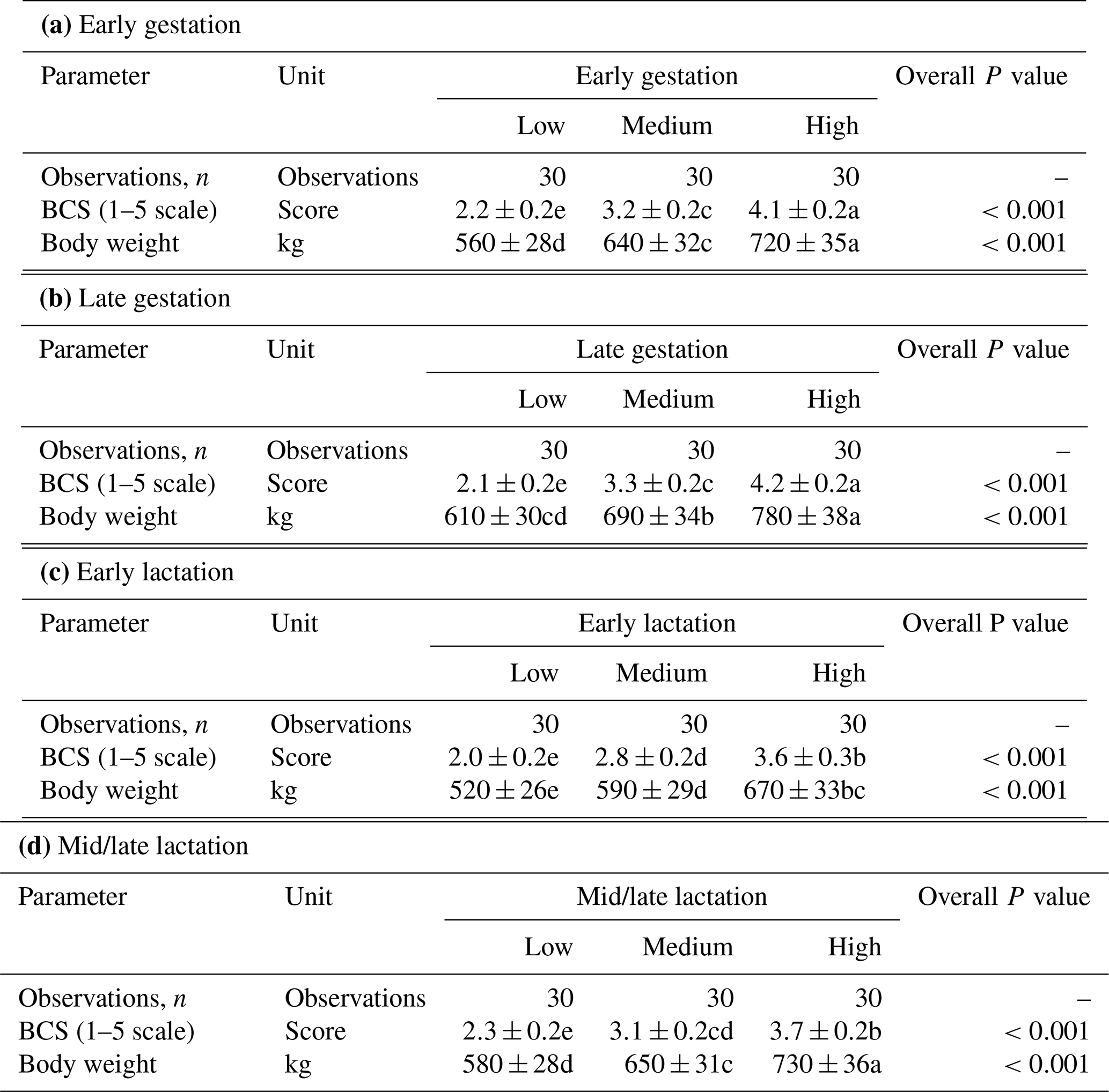
* Values are presented as mean ± SD. Ninety cows contributed 360 repeated cow-stage observations, with n=30 observations in each physiological-stage-by-concurrent-BCS cell. Means within the same row that do not share a common superscript letter differ significantly (P<0.05; Tukey-adjusted pairwise comparisons). The final column presents the overall P value for differences among the 12 cells. BCS, body condition score; SD, standard deviation.
3.2 Adipokine dynamics and thyroid–metabolic profiles
Serum asprosin concentrations varied significantly across physiological stages and BCS categories (P<0.001), reaching their nadir in early-gestation, high-BCS cows (9.8±0.8 ng mL−1) and peaking markedly in early-lactation, high-BCS cows (31.4±2.6 ng mL−1). Circulating resistin followed an analogous trajectory, displaying minimum concentrations in medium-BCS cows during early gestation (7.8±0.6 ng mL−1) and maximum concentrations in high-BCS cows during early lactation (21.8±1.9 ng mL−1; Table 3).
The early-lactation, high-BCS group simultaneously exhibited the most severe metabolic strain, characterized by peak concentrations of non-esterified fatty acids (NEFA: 0.88±0.16 mmol L−1) and β-hydroxybutyrate (BHBA: 1.25±0.22 mmol L−1), alongside the lowest circulating levels of glucose (31.8±3.0 mg dL−1), triiodothyronine (T3: 0.88±0.08 nmol L−1), and thyroxine (T4: 35.6±3.1 nmol L−1; P<0.001). As lactation advanced to mid/late lactation, metabolic homeostasis improved in high-BCS cows, with NEFA and BHBA declining to 0.32±0.07 mmol L−1 and 0.52±0.11 mmol L−1, respectively, while glucose (46.2±4.3 mg dL−1), T3 (1.90±0.15 nmol L−1), and T4 (70.0±5.0 nmol L−1) recovered toward baseline levels (Table 3).
Table 3Circulating adipokines, thyroid-metabolic indicators, and oxidative-status markers across physiological-stage-by-BCS cells in Holstein cows (N=90).
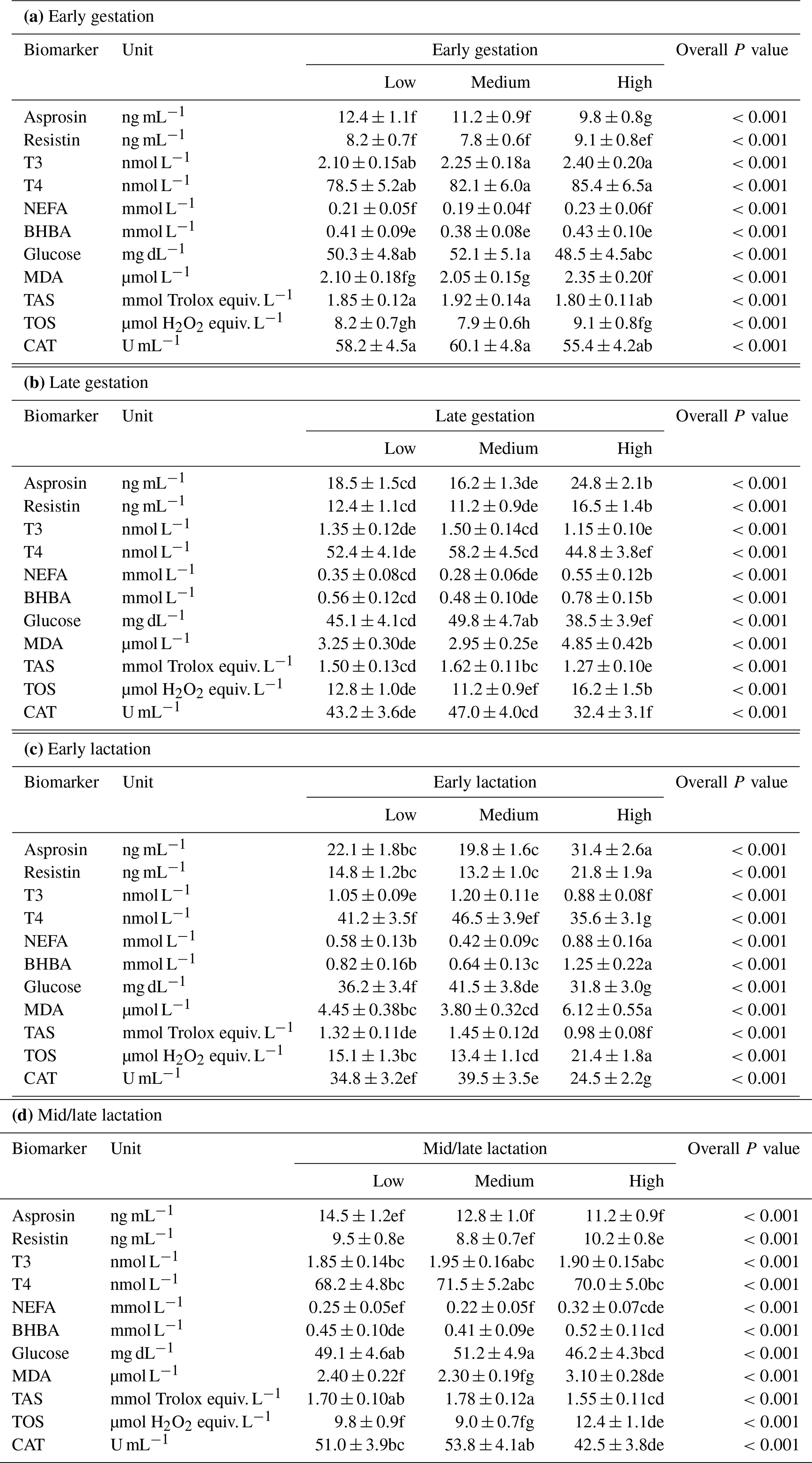
* Values are presented as mean ± SD. Ninety cows contributed 360 repeated cow-stage observations, with n=30 observations in each physiological-stage-by-concurrent-BCS cell. Means within the same row that do not share a common superscript letter differ significantly (P<0.05; Tukey-adjusted pairwise comparisons). The final column presents the overall P value for differences among the 12 cells. BCS, body condition score; BHBA, β-hydroxybutyrate; CAT, catalase; equiv., equivalents; MDA, malondialdehyde; NEFAs, non-esterified fatty acids; SD, standard deviation; T3, triiodothyronine; T4, thyroxine; TAS, total antioxidant status; TOS, total oxidant status.
The early-lactation, high-BCS cell also had the highest NEFA (0.88±0.16 mmol L−1) and BHBA (1.25±0.22 mmol L−1), together with the lowest glucose (31.8±3.0 mg dL−1), T3 (0.88±0.08 nmol L−1), and T4 (35.6±3.1 nmol L−1). By mid/late lactation, the corresponding high-BCS values were 0.32±0.07 mmol L−1 for NEFA, 0.52±0.11 mmol L−1 for BHBA, 46.2±4.3 mg dL−1 for glucose, 1.90±0.15 nmol L−1 for T3, and 70.0±5.0 nmol L−1 for T4.
3.3 Oxidative and antioxidant status profiles
Serum oxidative stress and enzymatic antioxidant indicators differed significantly across physiological stages and BCS categories (P<0.001; Table 3). The early-lactation, high-BCS group exhibited the most severe systemic oxidative burden, characterized by peak concentrations of malondialdehyde (MDA: 6.12±0.55 µmol L−1) and total oxidant status (TOS: 21.4±1.8 µmol H2O2 equivalents L−1), concurrent with the lowest total antioxidant status (TAS: 0.98±0.08 mmol Trolox equivalents L−1) and catalase activity (CAT: 24.5±2.2 U mL−1; Table 2). A pronounced oxidant challenge was also evident during late gestation in overconditioned animals, where high-BCS cows displayed elevated MDA (4.85±0.42 µmol L−1) and TOS (16.2±1.5 µmol H2O2 equivalents L−1) alongside compromised TAS (1.27±0.10 mmol Trolox equivalents L−1) and CAT (32.4±3.1 U mL−1; Table 3).
As animals transitioned from early to mid/late lactation within the high-BCS category, the oxidative stress profile improved substantially, reflecting cell-mean differences of 49.3 % lower MDA, 42.1 % lower TOS, 58.2 % higher TAS, and 73.5 % higher CAT activity in mid/late lactation. These percentage shifts represent relative differences between observational cell means and indicate progressive post-peak lactation recovery of antioxidant defences rather than direct causal effects.
3.4 Circulating asprosin, resistin, and redox–metabolic profiles across physiological stages and BCS in Holstein cows
All coefficients presented in Table 4 demonstrated statistical significance at P<0.001. Asprosin was positively correlated with resistin (r=0.684), NEFA (r=0.712), BHBA (r=0.695), MDA (r=0.665), and TOS (r=0.642) while displaying significant negative correlations with T3 (), glucose (), and TAS (). Similarly, circulating resistin correlated positively with NEFA (r=0.785), BHBA (r=0.762), MDA (r=0.742), and TOS (r=0.725) and exhibited marked inverse relationships with T3 (), glucose (), and TAS (). Among all evaluated metabolic indicators, the strongest positive correlation was observed between NEFA and BHBA (r=0.885), whereas MDA correlated positively with TOS (r=0.840) and negatively with TAS ().
Table 4Pearson correlation matrix among circulating adipokines, thyroid-metabolic indicators, and oxidative-status markers in Holstein cows (N=90).
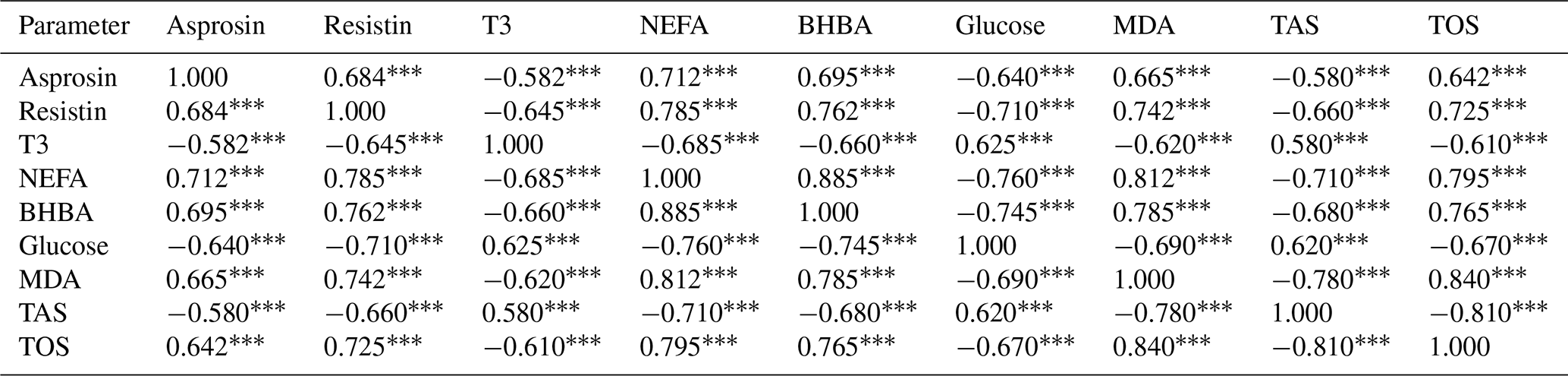
Values are two-sided Pearson correlation coefficients calculated from stage-averaged cow-level data (n=90 cows). ; ; . P values were not adjusted for multiple comparisons. BHBA, β-hydroxybutyrate; MDA, malondialdehyde; NEFA, non-esterified fatty acids; T3, triiodothyronine; TAS, total antioxidant status; TOS, total oxidant status.
The strongest positive correlation was between NEFA and BHBA (r=0.885). MDA correlated positively with TOS (r=0.840) and negatively with TAS (), while TAS and TOS were inversely correlated ().
This study investigated the effects of physiological stage and BCS on circulating asprosin, resistin, thyroid–metabolic indicators, and redox status in Holstein cows (P<0.001 for all outcomes). High BCS during early lactation was associated with the most pronounced metabolic and oxidative challenge, characterized by elevated asprosin, resistin, NEFA, BHBA, MDA, and TOS alongside reduced glucose, thyroid hormones, and antioxidant capacity (P<0.001). These biochemical patterns occurred concurrently with stage- and BCS-associated variations in physical characteristics and sensor-derived behavioural metrics (P<0.001).
Asprosin was initially described as a fasting-induced adipokine secreted from white adipose tissue that stimulates hepatic glucose release (Romere et al., 2016) and acts as an orexigenic signal regulating appetite through hypothalamic pathways (Duerrschmid et al., 2017). Circulating asprosin levels are thought to be directly linked to negative energy balance (NEB) and glucose regulation. In the present dataset, the occurrence of the highest asprosin concentration in the group with the lowest glucose level suggests that circulating asprosin may reflect the intensity of compensatory metabolic signalling rather than the successful restoration of glycaemia. This interpretation is consistent with the positive correlations of asprosin with NEFA and BHBA and its negative correlation with glucose. Furthermore, higher asprosin levels detected in individuals with a higher BCS (Köse et al., 2025) highlight the primary role of adipose tissue mass and lipolytic processes in the synthesis of this adipokine. The implications of these shifts in glucose and lipid metabolism for oxidative stress are evident. Increased adipose tissue mobilization (elevated NEFA) is known to trigger the production of reactive oxygen species (ROSs) in the liver and peripheral tissues (Song et al., 2014; Li et al., 2020). Köse et al. (2025) reported that total oxidant status (TOS) was significantly higher at baseline in Simmental cows with high asprosin (HA) levels, demonstrating a strong correlation between TOS and asprosin (AUC (Area Under the Curve) =0.711, cut-off >2.67 according to ROC analysis). These findings indicate that circulating asprosin levels may serve as a metabolic biomarker reflecting the risk of exposure to oxidative stress, either directly or indirectly through insulin resistance and increased lipolysis. Indeed, studies in other large animal species further confirm that circulating asprosin is closely associated with various physiological and biochemical parameters as well as tissue stress markers (Bayraktar and Tekce, 2021).
Resistin is an adipokine that serves as a key metabolic mediator connecting glucose metabolism, adipose tissue mobilization, and female reproductive physiology, acting as a pro-lipolytic regulator during NEB and physiological insulin resistance in early lactation (Reverchon et al., 2014; Qiao et al., 2024). In the present study, the interaction between physiological stage and BCS exerted a highly significant effect on circulating resistin concentrations (P<0.001), with the highest resistin levels recorded in high-BCS cows during early lactation (21.8±1.9 ng mL−1) and the lowest values observed in medium-BCS cows during early gestation (7.8±0.6 ng mL−1). Correlation analyses demonstrated that circulating resistin correlated strongly and positively with NEFA (r=0.785), BHBA (r=0.762), MDA (r=0.742), and TOS (r=0.725) while displaying marked inverse correlations with T3 (), glucose (), and TAS () (P<0.001). These findings align closely with longitudinal reports by Reverchon et al. (2014) and Weber et al. (2016), establishing that resistin peaks postpartum alongside elevated NEFA and BHBA to support lipid mobilization and insulin resistance. Specifically, Reverchon et al. (2014) demonstrated that elevated resistin during early lactation downregulates the phosphorylation of key insulin signalling components (IR-beta, IRS-1, Akt, and ERK1/2) in adipocytes, thereby inducing insulin resistance and activating the lipolytic enzymes ATGL (adipose triglyceride lipase) and HSL (hormone-sensitive lipase). Placentally, resistin has been reported to act synergistically with adiponectin, leptin, and visfatin to regulate feto-maternal nutrient transfer and support calf birth weight (CBW) (Shen et al., 2020). In contrast, in vitro studies indicate that resistin inhibits gonadotropin- and IGF1-induced estradiol secretion and cell proliferation in bovine granulosa and theca cells (Spicer et al., 2011; Maillard et al., 2011). The discrepancy between systemic/placental actions and local ovarian responses is thought to stem from the dual-functional role of resistin: during early lactation or NEB, elevated resistin enforces lipolysis in adipose tissue via ATGL/HSL while concurrently suppressing ovarian steroidogenesis and cell proliferation to restrain energy-expensive reproductive events, subsequently shifting toward supporting fetal growth via placental expression once pregnancy is established.
Negative energy balance, metabolic adaptations, and oxidative status represent core physiological processes mediating transition health and tissue mobilization in dairy cattle (Loor et al., 2013; Sordillo and Mavangira, 2014; Sundrum, 2015). In the present study, the simultaneous decrease in glucose, T3, and T4 alongside the marked increase in NEFA and BHBA during early lactation reflects physiological endocrine and metabolic adaptations driven by negative energy balance (P<0.001). These findings align with previous reports demonstrating that calving and early lactation are accompanied by reduced circulating thyroid hormone concentrations and elevated levels of lipid mobilization biomarkers, such as NEFA and BHBA (Nowroozi-Asl et al., 2016; Dehghan Shahreza et al., 2022). The mean BHBA concentration of 1.25 mmol L−1 observed in the early-lactation, high-BCS group approaches the established threshold for subclinical hyperketonemia, although group mean values may not directly classify individual cows or determine disease prevalence (Ospina et al., 2010b). Conversely, our results contrast with the limited literature reporting no significant alterations in thyroid function or energy metabolites relative to body condition during the transition period. This discrepancy may stem from variations in dietary energy density, sample size differences, or trial-period environmental conditions.
4.1 Strengths and limitations
Strengths include repeated evaluation of the same 90 cows across 4 physiological stages, balanced stage-by-BCS cell sizes, simultaneous measurement of 2 adipokines, thyroid and energy metabolites, and complementary oxidative and antioxidant markers. The use of concurrent BCS categories allowed body condition changes across stages to be represented rather than treating BCS as a permanent animal characteristic.
Several limitations should be considered. First, the observational design prevents causal inference. Second, all cows came from one commercial herd, limiting external generalizability. Third, the combined 12-level cell model provides an overall comparison and does not separately estimate physiological-stage, BCS, and stage-by-BCS interaction effects. Fourth, the cow-level correlation analysis used stage-averaged values and was exploratory; the P values were not adjusted for multiple testing. Fifth, potentially relevant covariates, including milk yield and environmental conditions, were not included in the reported models. Finally, the biomarker findings require confirmation with standardized assays, external herds, and prospective prediction of individual clinical outcomes.
This study demonstrated that high BCS during early lactation is associated with a pronounced metabolic and oxidative challenge, characterized by elevated levels of asprosin, resistin, NEFA, BHBA, MDA, and TOS, along with decreased concentrations of glucose, T3, T4, TAS, and CAT. Correlation analyses confirmed the association of asprosin and resistin with lipid mobilization, thyroid suppression, and oxidative stress. Asprosin and resistin represent potential biomarkers for metabolic profiling in Holstein cows; however, prospective studies are required for their clinical application. Overall, monitoring these parameters is anticipated to contribute significantly to the comprehensive assessment of metabolic status and tissue mobilization in dairy cattle.
The datasets generated and analysed during the current study are not publicly deposited in a repository due to commercial dairy farm confidentiality, proprietary herd management records, and ethical constraints governing institutional farm data. However, the complete datasets are available from the corresponding author upon reasonable request for non-commercial academic research.
The author has declared that there are no competing interests.
The study protocol was approved by the Animal Experiments Ethics Committee of the Veterinary Control Central Research Institute (7 May 2026; decision no. 2026-0211). All procedures were conducted in accordance with applicable national and international animal-welfare requirements. Written informed consent was obtained from the owner of the commercial dairy enterprise for animal inclusion, biological sampling, and use of farm records.
Publisher's note: Copernicus Publications remains neutral with regard to jurisdictional claims made in the text, published maps, institutional affiliations, or any other geographical representation in this paper. The authors bear the ultimate responsibility for providing appropriate place names. Views expressed in the text are those of the authors and do not necessarily reflect the views of the publisher.
The author would like to thank the farm owners and staff for their cooperation and assistance during the animal sampling process.
This paper was edited by Steffen Maak and reviewed by Bülent Bayraktar, Tuğçe Orkun Erkılıç, Marko Cincović, and two anonymous referees.
Ashar, M. J., Gonzalez-Rivas, P. A., Dunshea, F. R., Marth, C. D., and Chauhan, S. S.: Integrative insights into metabolic, oxidative, and immune adaptations during the transition period in dairy cows: revisiting nutritional strategies and emerging roles of injectable trace minerals, Dairy, 7, 15, https://doi.org/10.3390/dairy7010015, 2026.
Aydemir, Ş., Bayraktar, B., Kotan, G. C., Kebapcı, E., and Tekce, E.: General structure of cattle farming enterprises and basic care and feeding practices of breeders: the example of Çorum city center, J. Agri. Pro., 7, 2–12, https://doi.org/10.56430/japro.1767551, 2026.
Bayraktar, B. and Genç, M.: The effect of change in body condition score at different stages of pregnancy on serum apelin-36 hormone levels in Simmental cattle, J. Anim. Vet. Adv., 20, 81–85, 2021.
Bayraktar, B. and Tekce, E.: Investigation of the effect of age, gender and seasonal change on the level of serum asprosin in Trakya horses, Pferdeheilkunde, 37, 518–524, https://doi.org/10.21836/PEM20210508, 2021.
Bernabucci, U., Ronchi, B., Lacetera, N., and Nardone, A.: Influence of body condition score on relationships between metabolic status and oxidative stress in periparturient dairy cows, J. Dairy Sci., 88, 2017–2026, https://doi.org/10.3168/jds.S0022-0302(05)72878-2, 2005.
Dehghan Shahreza, F., Seifi, H. A., and Mohri, M.: The relationship between body condition score, thyroxin, health condition, serum energy indices, insulin-like growth factor-1, and lipid profile over the transition period in Holstein dairy cows, Iran. J. Vet. Res., 23, 111–119, https://doi.org/10.22099/IJVR.2022.40668.5890, 2022.
Duerrschmid, C., He, Y., Wang, C., Li, C., Bournat, J. C., Romere, C., Saha, P. K., Lee, M. E., Phillips, K. J., Jain, M., Jia, P., Zhao, Z., Farias, M., Wu, Q., Milewicz, D. M., Sutton, V. R., Moore, D. D., Butte, N. F., and Chopra, A. R.: Asprosin is a centrally acting orexigenic hormone, Nat. Med., 23, 1444–1453, https://doi.org/10.1038/nm.4432, 2017.
Edmonson, A. J., Lean, I. J., Weaver, L. D., Farver, T., and Webster, G.: A body condition scoring chart for Holstein dairy cows, J. Dairy Sci., 72, 68–78, https://doi.org/10.3168/jds.S0022-0302(89)79081-0, 1989.
Islam, M. S.: Metabolic vulnerability and immune challenge: interactions between inherited disorders, metabolic syndrome, and infection risk, J. Prev. Diagn. Treat. Strateg. Med., 5, 153–161, https://doi.org/10.4103/jpdtsm.jpdtsm_22_26, 2026.
Kılınç, M. A., Rişvanlı, A., Şafak, T., Yılmaz, Ö., Yüksel, B. F., and Şeker, İ.: The relationship of blood asprosin levels and biochemical parameters in pregnant cows, Türk Doğa ve Fen Dergisi, 11, 111–116, https://doi.org/10.46810/tdfd.1092040, 2022.
Köse, R., Akarsu, S. A., Kurt, S., Serin, H., Aydın, M. A., Karahanlı, A., Uçak, G., and Yörü, A.: Investigation of the effect of asprosin level on fertility success and oxidative stress in Simmental cows, Reprod. Domest. Anim., 60, e70022, https://doi.org/10.1111/rda.70022, 2025.
Kotan, G. C., Bayraktar, B., Aydemir, Ş., Tekce, E., and Sucu, E.: Çorum ili süt sığırcılığı işletmelerinin biyogüvenlik uygulamaları açısından değerlendirilmesi, Osmaniye Korkut Ata Üniversitesi Fen Bilimleri Enstitüsü Dergisi, 9, 1529–1549, https://doi.org/10.47495/okufbed.1769752, 2026a.
Kotan, G. C., Bayraktar, B., and Aydemir, Ş.: Sığırlarda fetal programlama: gebelik beslenme stratejilerinin epigenetik mekanizmalar ve üretim performansı üzerindeki etkileri, Akademik Et ve Süt Kurumu Dergisi, 11, 82–90, 2026b.
Kotan, G. C., Bayraktar, B., Aydemir, Ş., Aksakal, V., Altun, H. Ü., Tekce, E., and Erdoğan, Y.: Investigation of managerial practices related to calves' survival in dairy cattle farms: the case of Çorum Province, Turk. J. Agric. Food Sci. Technol., 14, 1078–1085, https://doi.org/10.24925/turjaf.v14i4.1078-1085.8524, 2026c.
Li, Y., Ding, H., Liu, L., Song, Y., Du, X., Feng, S., Zhang, C., Shen, T., Wang, Z., and Li, X.: Non-esterified fatty acid induces dairy cow hepatocyte apoptosis via the mitochondria-mediated ROS–JNK/ERK signaling pathway, Front. Cell Dev. Biol., 8, 245, https://doi.org/10.3389/fcell.2020.00245, 2020.
Loor, J. J., Bionaz, M., and Drackley, J. K.: Systems physiology in dairy cattle: nutritional genomics and beyond, Annu. Rev. Anim. Biosci., 1, 365–392, https://doi.org/10.1146/annurev-animal-031412-103728, 2013.
Maillard, V., Froment, P., Ramé, C., Uzbekova, S., Elis, S., and Dupont, J.: Expression and effect of resistin on bovine and rat granulosa cell steroidogenesis and proliferation, Reproduction, 141, 467–479, https://doi.org/10.1530/REP-10-0419, 2011.
Nowroozi-Asl, A., Aarabi, N., and Rowshan-Ghasrodashti, A.: Ghrelin and its correlation with leptin, energy-related metabolites and thyroidal hormones in dairy cows in the transitional period, Pol. J. Vet. Sci., 19, 197–204, https://doi.org/10.1515/pjvs-2016-0024, 2016.
NRC: Nutrient Requirements of Dairy Cattle, 7th rev. edn., National Academy Press, Washington, DC, ISBN 978-0-309-06997-7, 2001.
O'Connor, A. M., Sargeant, J. M., Dohoo, I. R., Erb, H. N., Cevallos, M., Egger, M., Ersbøll, A. K., Martin, S. W., Nielsen, L. R., and Pearl, D. L.: Explanation and elaboration document for the STROBE-Vet statement, J. Vet. Intern. Med., 30, 1896–1928, https://doi.org/10.1111/jvim.14592, 2016.
Ospina, P. A., Nydam, D. V., Stokol, T., and Overton, T. R.: Associations of elevated nonesterified fatty acids and β-hydroxybutyrate concentrations with early lactation reproductive performance and milk production in transition dairy cattle in the northeastern United States, J. Dairy Sci., 93, 1596–1603, https://doi.org/10.3168/jds.2009-2852, 2010a.
Ospina, P. A., Nydam, D. V., Stokol, T., and Overton, T. R.: Evaluation of nonesterified fatty acids and β-hydroxybutyrate in transition dairy cattle in the northeastern United States: critical thresholds for prediction of clinical diseases, J. Dairy Sci., 93, 546–554, https://doi.org/10.3168/jds.2009-2277, 2010b.
Qiao, K., Jiang, R., Contreras, G. A., Xie, L., Bogado Pascottini, O. A., Opsomer, G., and Dong, Q.: The complex interplay of insulin resistance and metabolic inflammation in transition dairy cows, Animals, 14, 832, https://doi.org/10.3390/ani14060832, 2024.
Reverchon, M., Ramé, C., Cognié, J., Briant, E., Elis, S., Guillaume, D., Froment, P., and Dupont, J.: Resistin in dairy cows: plasma concentrations during early lactation, expression and potential role in adipose tissue, PLoS One, 9, e93198, https://doi.org/10.1371/journal.pone.0093198, 2014.
Roche, J. R., Friggens, N. C., Kay, J. K., Fisher, M. W., Stafford, K. J., and Berry, D. P.: Invited review: body condition score and its association with dairy cow productivity, health, and welfare, J. Dairy Sci., 92, 5769–5801, https://doi.org/10.3168/jds.2009-2431, 2009.
Romere, C., Duerrschmid, C., Bournat, J., Constable, P., Jain, M., Xia, F., Saha, P. K., Del Solar, M., Zhu, B., York, B., Han, C., Clifford, B. L., Gao, N., Zhang, F., Scherer, P. E., Milewicz, D. M., Yang, J., Moore, D. D., and Chopra, A. R.: Asprosin, a fasting-induced glucogenic protein hormone, Cell, 165, 566–579, https://doi.org/10.1016/j.cell.2016.02.063, 2016.
Sait, A., Bayraktar, B., Korkmaz, S., Genç, M., Bayraktar, S., Kotan, G. C., Aydemir, Ş., Takma, Ç., Bülbül, A. S., Aksakal, V., Tekce, E., Böyük Özcan, G. B., Kaya, H., and Odabaşı, M.: Investigation of the relationship between apelin hormone response and some physiological parameters in enzootic bovine leukosis virus infected cattle, J. Hellenic Vet. Med. Soc., 75, 8191–8196, https://doi.org/10.12681/jhvms.34664, 2025.
Sait, A., Bayraktar, B., Korkmaz, S., İnce, Ö. B., and Tezcan, E.: Assessment of the relationship between telomere length and physiological parameters in cattle infected with bovine leukosis virus, Osmaniye Korkut Ata Üniversitesi Fen Bilimleri Enstitüsü Dergisi, 9, 744–759, https://doi.org/10.47495/okufbed.1723237, 2026.
Sargeant, J. M., O'Connor, A. M., Dohoo, I. R., Erb, H. N., Cevallos, M., Egger, M., Ersbøll, A. K., Martin, S. W., Nielsen, L. R., and Pearl, D. L.: Methods and processes of developing the Strengthening the Reporting of Observational Studies in Epidemiology-Veterinary (STROBE-Vet) statement, J. Vet. Intern. Med., 30, 1887–1895, https://doi.org/10.1111/jvim.14574, 2016.
Sarno, R. D., Abdoun, K. A., Al-Badwi, M. A., Samara, E. M., and Al-Haidary, A. A.: Hormonal regulation of metabolic and reproductive homeostasis in transition dairy cows: current insights and future perspectives, Anim. Reprod. Sci., 292, 108274, https://doi.org/10.1016/j.anireprosci.2026.108274, 2026.
Shen, L., Zhu, Y., Xiao, J., Qian, B., Jiang, T., Deng, J., Zhang, Y., Tan, X., Zhang, S., and Sun, P.: Relationships between placental adiponectin, leptin, visfatin and resistin and birthweight in cattle, Reprod. Fertil. Dev., 32, 402–408, https://doi.org/10.1071/RD18247, 2020.
Song, Y., Li, X., Li, Y., Li, N., Shi, X., Ding, H., Zhang, Y., Shen, T., Wang, Z., and Liu, G.: Non-esterified fatty acids activate the ROS–p38–p53/Nrf2 signaling pathway to induce bovine hepatocyte apoptosis in vitro, Apoptosis, 19, 984–997, https://doi.org/10.1007/s10495-014-0982-3, 2014.
Sordillo, L. M. and Aitken, S. L.: Impact of oxidative stress on the health and immune function of dairy cattle, Vet. Immunol. Immunopathol., 128, 104–109, https://doi.org/10.1016/j.vetimm.2008.10.305, 2009.
Sordillo, L. M. and Mavangira, V.: The nexus between nutrient metabolism, oxidative stress and inflammation in transition cows, Anim. Prod. Sci., 54, 1204–1214, https://doi.org/10.1071/AN14503, 2014.
Spicer, L. J., Schreiber, N. B., Lagaly, D. V., Aad, P. Y., Douthit, L. B., and Grado-Ahuir, J. A.: Effect of resistin on granulosa and theca cell function in cattle, Anim. Reprod. Sci., 124, 19–27, https://doi.org/10.1016/j.anireprosci.2011.01.005, 2011.
Sundrum, A.: Metabolic disorders in the transition period indicate that the dairy cows' ability to adapt is overstressed, Animals, 5, 978–1020, https://doi.org/10.3390/ani5040395, 2015.
Weber, M., Locher, L., Huber, K., Kenéz, Á., Rehage, J., Tienken, R., Meyer, U., and Dänicke, S.: Longitudinal changes in adipose tissue of dairy cows from late pregnancy to lactation. Part 1: the adipokines apelin and resistin and their relationship to receptors linked with lipolysis, J. Dairy Sci., 99, 1549–1559, https://doi.org/10.3168/jds.2015-10131, 2016.
Zhang, Z., Guo, S., Yang, J., Hou, X., Zhang, X., Liu, H., Wang, J., and Shi, Z.: Early-onset negative energy balance in transition dairy cows increases the incidence of retained fetal membranes, Animals, 16, 229, https://doi.org/10.3390/ani16020229, 2026.
We investigated metabolic adaptations in dairy cows transitioning from pregnancy to lactation. By monitoring 90 cows across 4 biological stages, we found that overweight cows face severe metabolic and oxidative stress after calving, reflected by higher asprosin and resistin levels. Tracking these markers helps optimize feeding and improve herd welfare.
We investigated metabolic adaptations in dairy cows transitioning from pregnancy to lactation....